You leave it on emergency heat
Your house stays warm while the strip heat carries the whole load. It costs more to run every day it's on, and that adds up fast on a Delaware power bill.
 Hand off my repair
Get the heat pump repair search off your mind today.
Your thermostat shows "Em. Heat" or the system has switched on by itself, and you're trying to figure out what that means for your house. Emergency heat means your heat pump has stopped moving heat from outside and the backup heat source, usually electric resistance coils, is carrying the load instead. It's not a failure on its own. It's a mode. But if it turned on without you touching the thermostat, something in the heat pump likely isn't working, and that's worth a look.
Here in Delaware, most homes you'd compare yours to heat with gas, so a heat pump running on backup heat stands out. Electric heat costs more to run than the heat pump does normally, and power here isn't cheap. Left on for days without the heat pump doing its share, that shows up on the next bill.
You don't need to figure out whether it's the defrost control, a stuck reversing valve, or something in the outdoor unit. That part isn't yours to solve. What's yours right now is deciding whether to wait it out or get someone to look at it, and if the heat pump isn't contributing at all, waiting usually costs you more than it saves.
Once you send the form, you're done with the part that eats the afternoon: searching for someone who works on heat pumps instead of just furnaces, calling two or three companies, explaining the same thing each time, waiting on callbacks that don't come, then sorting through quotes to see who actually knows this equipment. That whole search ends when you submit. Someone who works on heat pumps gets your situation and takes it from there. You stop carrying it.
The rest of this page walks through what emergency heat actually does, why your system might have switched to it, and what to check before deciding your next step.
Emergency heat means your heat pump's outdoor unit has stopped pulling heat from the air, and your system has switched to backup heat only, usually an electric strip or furnace. In Delaware, this happens most when ice builds up on the outdoor coil faster than the defrost cycle can clear it, or when the outdoor unit fails outright during a cold snap. The thermostat setting itself just tells the system to skip the outdoor unit and run backup heat directly. Your house will stay warm either way. What changes is the cost and the cause. Electric backup heat costs more to run than the heat pump, and with power priced the way it is here, that difference shows up fast if the system stays on backup for days. If you switched it on because the outdoor unit looked frozen or wasn't running, that's a sign the heat pump needs a look, not just a thermostat fix.




That electric strip heat will keep your house warm, but it costs more to run than your heat pump does, and the longer it runs, the more it shows up on your bill. Power in Delaware isn't cheap, and most homes here lean on gas for heat precisely because electric resistance heat runs expensive. Emergency heat mode is backup for a reason. It's meant to carry you through until the outdoor unit gets looked at, not to be your heat all winter. Figuring out why the heat pump stopped pulling heat outside, whether it's frozen up, low on refrigerant, or something electrical, takes a contractor who can get out to your house and look at the unit directly. Instead of searching around, calling a few companies, and explaining the same problem over and over while your thermostat sits on emergency heat, send the request once. Your house stays warm either way. The difference is how long you're paying the higher rate before someone fixes the actual problem.
A heat pump in emergency heat mode isn't producing less heat. It's making all that heat with electric resistance coils instead of the outdoor unit, the same way a space heater or an old electric baseboard does.
That's why the switch shows up on your bill before it shows up anywhere else. Your house stays warm either way, but the electric strips are doing work your heat pump's compressor used to do for less.


Your house stays warm while the strip heat carries the whole load. It costs more to run every day it's on, and that adds up fast on a Delaware power bill.
A contractor finds why the outdoor unit stopped pulling heat, whether that's ice, a frozen reversing valve, or a failed sensor, and gets it back to doing the work the strips are covering now.
At 17.15 cents a kilowatt-hour, every day your system runs on emergency heat instead of the heat pump costs you more than it has to. The strip heat has to make all of that warmth from electricity alone, and in Delaware that electricity isn't cheap.
EIA-861 2025 statewide residential average

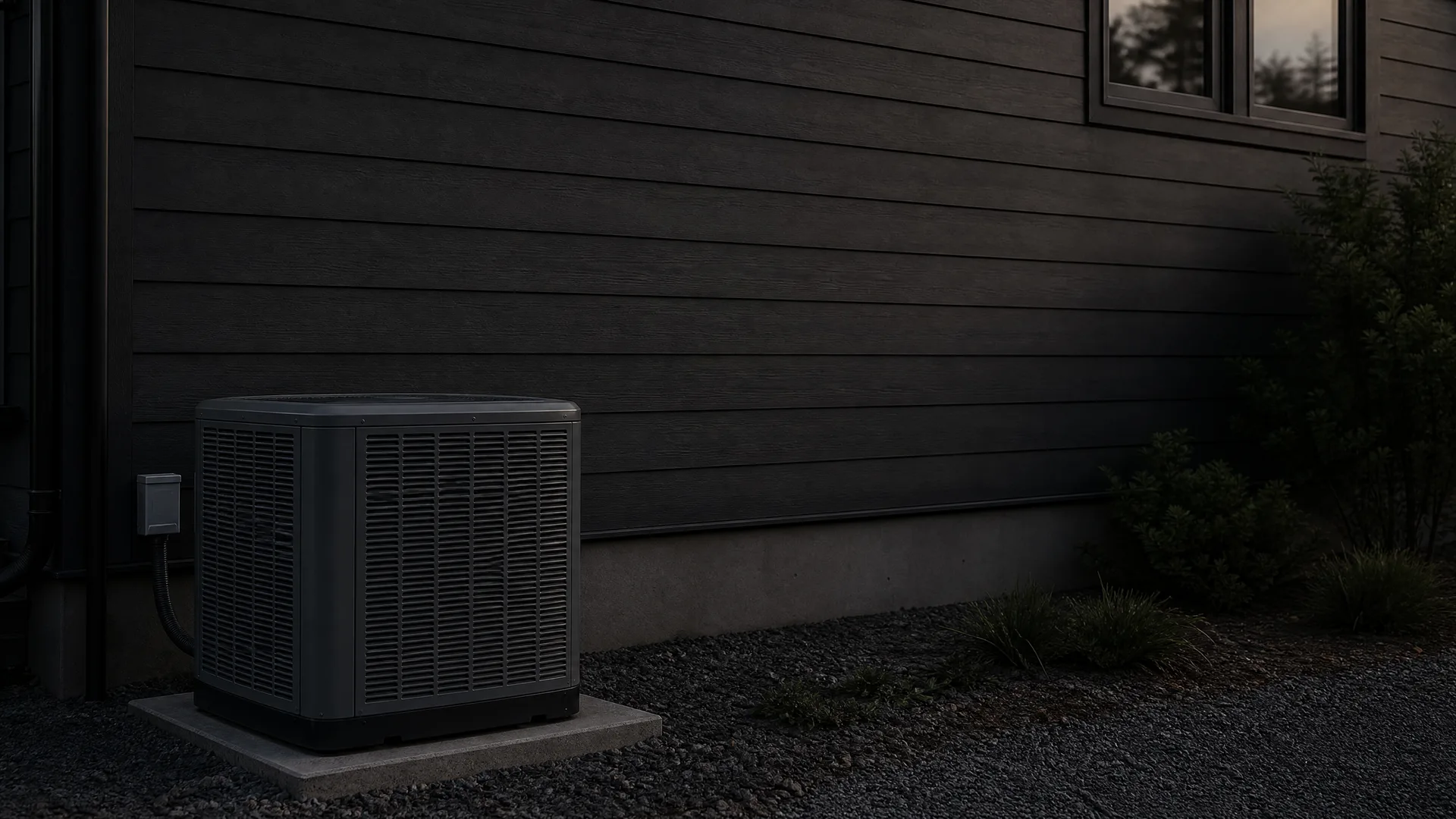
This is what the outdoor unit looks like when it's doing its job. Air moves freely through the fins, the coil stays clear, and the system pulls heat out of the air even on a cold Delaware night. No ice, no debris, nothing blocking the airflow it needs.

Dirt, leaves and grime packed into the grille block the airflow the coil needs to pull heat from outside air. A unit this clogged can't move enough heat to keep up, and that's often what pushes the system into emergency heat. A contractor can clean it and check what else the buildup affected.

Your system switching to emergency heat is telling you one thing: the outdoor unit stopped pulling heat from the air, and the electric strip is carrying the house by itself. That keeps you warm tonight, but it doesn't explain why the outdoor unit quit, and it doesn't stop the strip from running up your bill every hour it's on.
A contractor can look at the outdoor unit and tell you what stopped it, whether it's ice that isn't melting off, a part that failed, or something else, and get the heat pump carrying the load again. Sending the form means you're not the one calling around Delaware for someone who services heat pumps, waiting on callbacks, or explaining the thermostat and the ice and the bill to three different people before anyone shows up. That part is off your plate once you send it.

Skip searching for a heat pump pro and answer a few questions instead.