Profile view of a bearded man wearing a dark green baseball cap and a dark gray T-shirt against a plain light background.

Why your heat pump keeps short cycling in Delaware

Step 1 of 3: Equipment

Why does my heat pump keep short cycling?

A heat pump that turns on, runs for a few minutes, then shuts off and starts again is short cycling. It wears on the compressor and it leaves rooms uneven, warm in one spot and cold in the next, right when you need the house to hold steady for everyone in it.

A bad sensor, a dirty filter, or a unit too big for the house

Short cycling usually comes down to one of a few things. A thermostat sensor reading the wrong temperature will shut the system off before the house is actually comfortable. A clogged filter or a frozen coil chokes airflow, so the unit overheats or trips on pressure and restarts. And some heat pumps are simply oversized for the space, so they blast the house to temperature fast and shut off, then start again minutes later. In Delaware, where summer humidity makes people lean on AC hard and winter has most homes running gas heat instead, a heat pump handling cooling and shoulder-season heat sees a lot of on-off cycles, so a part already running marginal wears out faster than it would somewhere milder.

An outdoor condenser unit encased in thick ice stands on snow beside a house with horizontal siding and exterior pipes, with bare trees and a sunset glow in the background.

You're up before the sun, coffee in hand, and the kitchen window shows the side yard still dark except for the porch light. The outdoor unit sits there with a thick collar of ice climbing up its side, past the lower vents. It clicked on twenty minutes ago and it's already stopped. You can hear it try again, a short hum, then quiet. Frost has crept over the top grille too. Inside, the air coming from the vents feels barely warm, and the thermostat still reads three degrees under where you set it. The dog won't go near the back door. Somewhere upstairs a kid is asking why it's cold.

Is It the Size or a Part

Oversized Unit

  • A heat pump sized too large for the house satisfies the thermostat fast, often inside a few minutes, then shuts down before it finishes a full cycle.
  • It cools or heats the air near the thermostat quickly but never runs long enough to pull moisture out of the house, so rooms feel sticky even when the temperature reads fine.
  • Correcting this means a contractor checking the unit's capacity against the size of your house, not just patching the symptom.
  • Short runs like this put more wear on the compressor over time than longer, steady ones would.
  • If the system was installed as part of a larger renovation or addition, the load on the house may no longer match what the unit was sized for.

Failing Part

  • A dirty flame sensor, weak capacitor, failing thermostat, or low refrigerant charge can all cause the same on off on pattern even in a correctly sized unit.
  • A thermostat that misreads the temperature can tell the unit to shut off long before the house has actually reached the set point.
  • Low refrigerant lowers pressure in the system enough to trip the safety switch that protects the compressor, cutting the cycle short.
  • A clogged air filter or blocked outdoor coil restricts airflow until the unit overheats and shuts itself down as a protection, then starts again once it cools.
  • These failures tend to get worse, not better, so a unit short cycling today is likely to short cycle more often next month.
  • A contractor can test each part directly rather than guessing which one is behind it.
A woman with long wavy brown hair in a grey ribbed sweater sits on a couch indoors, looking toward a window, with a potted palm-like plant and fireplace behind her.
A woman with long brown hair wearing a green V-neck top and beige cardigan sits on a light sofa, looking off to the side, with a dining table, lamp and framed picture in the background.
A woman with long dark hair in a cream knit sweater sits on a beige sofa indoors, looking toward a bright window with a houseplant and framed picture in the background.
A woman with long dark hair in a green knit sweater sits on a couch indoors, smiling and looking toward a window with a blurred room behind her.
A woman stands in the open doorway of a white stucco house holding the dark door, facing a man in a black cap and shirt seen from behind in the blurred foreground, with a potted flowering plant beside the entry.

What's happening inside the unit when it short cycles

A heat pump starts a cycle when the thermostat calls for heat or cool, the compressor kicks on, and refrigerant moves between the outdoor coil and the indoor coil to move heat in or out of the house. That cycle is supposed to run until the house reaches the set temperature, then rest. Short cycling means something is cutting that run short before the compressor and coils ever get up to a steady state. A low refrigerant charge makes the system read pressures that look like it already hit target. A dirty outdoor coil, caked with pollen or grass clippings from a Delaware summer, chokes the airflow the same way. Either one trips a safety switch that shuts the compressor down early, and the thermostat just calls for another cycle a few minutes later.

None of this is something you fix by watching the unit run. It takes someone checking refrigerant pressures, pulling the panel off the outdoor coil, and testing the safety switches with gauges, not guesswork. A contractor who's worked on heat pumps in Delaware homes will know which of these to check first and can get you fixed up without you having to describe the problem three times to three different people before someone shows up with the right parts on the truck.

Interior corner of a dining room with a round wooden table, a ceramic vase holding olive branches, a dark spindle-back chair near a curtained window, and a sideboard with a lamp against beige walls.
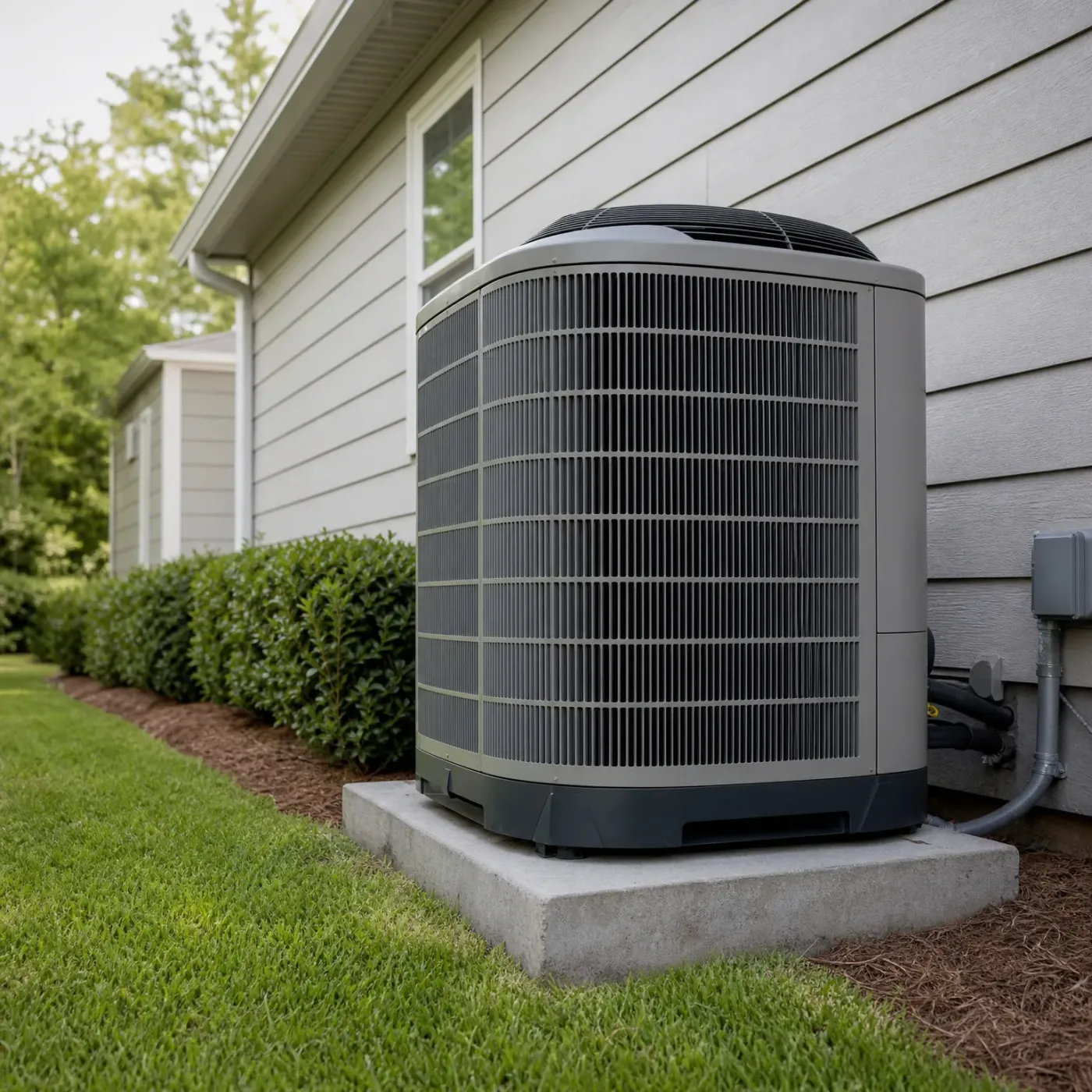
A gray outdoor condenser unit on a raised pad beside a house with horizontal lap siding, with refrigerant lines, conduit and an electrical disconnect box on the wall, and shrubs on a mulch bed to the left.

Running clean

The unit sits level on its pad, lines and wiring connecting it to the disconnect box without strain. Air moves freely around all four sides. A heat pump in this shape can still short cycle from a bad capacitor or a stuck valve, but at least it isn't fighting its own surroundings to run a full cycle.


An outdoor air conditioner condenser unit on a gray composite pad beside a house with horizontal lap siding, with refrigerant lines and a conduit running to a wall-mounted disconnect box, and a shrub at left.

Caked in grime

Dirt and debris cover the coil fins on this unit, the kind of buildup that blocks airflow through the coil. A heat pump working through that film runs hotter and trips its safety switches sooner, cutting cycles short again and again. The grime doesn't cause every short cycling problem, but it makes most of them worse.

A smiling older woman with gray hair in a cream knit sweater stands in a dimly lit kitchen beside a window showing snow outside, with a round loaf of bread on the counter in the foreground.
A woman and a child wrapped together in a thick knitted blanket on a sofa, both with eyes closed, with a lit table lamp and houseplant in the dim background.

What a normal cycle looks like

A heat pump that's sized and running right will stay on for ten to twenty minutes at a stretch once it starts, longer on the coldest or hottest days. It ramps up, holds steady, and shuts off only after the thermostat's target is actually met through the whole house, not just near the vent. You'll hear it run through a full cycle without the clicking on and off every few minutes. That steady run is what pulls the humidity down in a Delaware summer and keeps rooms even in January. Short runs mean the unit never gets the chance to do that part of its job, even if the air coming out feels fine for a minute.

What short cycling costs the system

Every start draws a hard jolt of current through the compressor, more than it pulls once it's running steady. A unit that starts and stops every few minutes is putting that strain on the compressor dozens of times a day instead of a handful. With power costs in Delaware already high, a compressor working through constant restarts instead of smooth run time adds to the draw and shortens how long it lasts before it needs real repair. The wear shows up in the compressor and the contactor first, often well before the rest of the unit would otherwise wear out.

A weathered outdoor condenser unit on a concrete pad beside a house with white horizontal vinyl siding, with refrigerant lines and conduit running to a wall-mounted electrical box.
Before you get your heat pump repair
A gray outdoor heat pump unit with a large fan grille sits on a concrete pad beside a house with horizontal lap siding, next to a green shrub, mulch bed, and lawn.
After you get your heat pump repair
An outdoor condenser unit on a concrete pad beside a light-colored lap-sided house, with a trimmed hedge, mulch bed and mowed lawn nearby and an electrical box and conduit on the wall.

A heat pump pro near you

One form replaces the calls you'd make to find a heat pump pro.

Say what's going on with your heat pump, and a pro who works on them reaches out.

Match me with a pro

It costs nothing to send, and you don't have to hire anyone.

What are you noticing around the house right now

You hear the outdoor unit click on and the compressor hum, then it cuts out before the room ever feels different. A few minutes later it starts again. Upstairs stays warm while the living room never quite gets there, so you're adjusting the thermostat more than you used to. The vents blow but the air doesn't feel like it's doing much. Your power bill has crept up even though you haven't changed how you run the system. Left alone, this keeps wearing on the compressor, and with power priced the way it is here, you're paying more for a system that's working harder and heating or cooling less of the house.

A single-story gray horizontal-siding house with multiple front-facing gables, white-trimmed windows, a dark front door, and a concrete walkway crossing a partly dry lawn under a clear blue sky.

Summer air in Delaware holds a lot of moisture, averaging a dew point of 65°F across June, July and August, according to NOAA climate normals. A heat pump has to pull that moisture out of the air along with the heat, and that takes longer per cycle than cooling dry air does. If the unit is already short cycling, that sticky air keeps the indoor coil wetter and makes it harder for the system to catch up once it shuts off early. You'll notice it most as a house that feels cool but still damp, with rooms that never quite dry out between cycles.

NASA POWER T2MDEW county cells weighted by homes

A gray outdoor condenser unit on a concrete pad beside a white horizontal-siding house, with refrigerant lines and conduit running to a wall-mounted disconnect box, bare soil in front and a green shrub at left.
This unit cycles on steady power draw, lines and wiring sitting clean against the wall, nothing fighting the airflow around it.
An outdoor air conditioning condenser unit on a concrete pad beside a house with light horizontal siding and a concrete block foundation, with bare soil and small green plants around it.
Grime packed into the fins chokes the airflow, so the unit works harder and shuts off faster than it should.

The five things that cause it

  • A low refrigerant charge makes the compressor work against a pressure it can't satisfy, so a safety switch cuts it off early.
  • Dirty outdoor coil fins trap heat against the unit, raising head pressure until a high pressure switch trips and shuts the compressor down.
  • A thermostat mounted near a supply vent or in direct sun reads the temperature wrong and tells the system it's done before the house actually is.
  • A failing run capacitor can't hold the charge needed to keep the compressor motor spinning, so it stalls and restarts in short bursts.
  • A stuck or slow reversing valve leaves the system fighting itself between heat and cool, and the control board shuts it down to protect the compressor.
  • Loose or corroded wiring at the contactor can break the circuit under normal vibration, cutting power mid cycle for no reason the thermostat can see.

A short cycling heat pump is almost always one of a handful of things, and most of them trace back to pressure or power. Refrigerant charge is the one that surprises people. Too low, and the compressor can't build the pressure it needs, so a safety switch cuts power before damage happens. The fix isn't adding refrigerant and hoping. It means finding where it's leaking out, because a sealed system doesn't lose charge on its own. Outside, the coil fins do a job most homeowners never think about: they let the unit dump heat into the air. Pack those fins with grass clippings, cottonwood, or a season of grime, and the pressure climbs until a high pressure switch trips. A thermostat in the wrong spot causes a different kind of trouble. One mounted above a supply vent or catching afternoon sun through a window reads a temperature that isn't the room's real temperature, so it shuts the system off before the house is actually comfortable. Inside the unit, a run capacitor holds the charge that keeps the compressor motor turning steadily. When it starts failing, the motor stalls and the unit restarts over and over trying to catch. A reversing valve stuck between heat and cool positions, or a loose connection at the contactor flexing under normal vibration, both do the same thing from different directions: they cut the cycle short before the thermostat ever sees a reason to.

Power costs 17.15 cents per kilowatt-hour statewide

A heat pump that short cycles pulls hard on your power without ever finishing a run. At 17.15 cents per kilowatthour, those repeated starts and stalled cycles show up on your bill even though the house never feels fully heated or cooled.

EIA-861 2025 statewide residential average

A heat pump that keeps shutting off and restarting isn't going to fix itself, and the short runs add up on a power bill that's already high. The cause sits somewhere specific: a thermostat in the wrong spot, a unit sized wrong for the house, a dirty coil, a refrigerant leak, a failing part. Finding which one it is means someone has to look at the actual unit outside your house, not guess from a list. That's the part you don't have to carry on your own. Instead of searching through contractors, calling a few, explaining the same thing about the clicking and the ice and the uneven rooms over and over, then sitting with quotes trying to compare one against another, you answer a short set of questions once and get matched with a contractor who handles this kind of repair. They reach out to you from there. Your winters run on gas, but the heat pump carries the muggy months, and right now it isn't finishing a single one of its runs. That's worth getting looked at.

Sunlight falls across a beige upholstered sofa with a textured woven cushion and a chunky knit throw, beside a dark wood cabinet holding a ceramic vase with green leafy branches, near a white-framed window.
A sunlit corner of a room with a wooden side table holding a ceramic vase of green foliage and a wooden bowl, beside a light upholstered sofa with a knit throw and rust-colored pillow, with window shadows cast on a beige wall.
A sunlit room corner with beige walls, a white-framed window with sheer cream curtain, wood floor with a light rug, and a woven basket holding a knit blanket.
A beige ceramic vase holding a leafy green branch sits on a wooden cabinet in a corner, with sunlight through a sheer curtain casting leaf shadows on the wall.
A grey upholstered sofa with a rust-orange velvet cushion and a textured throw sits beside a window with linen curtains, next to a wooden side table holding a pale ceramic vase of olive branches.

A local pro for your heat pump repair

Describe what your heat pump is doing once, in one form.

Skip the calls

No charge to send it. You decide if you hire them.